CrochetPatternGen

Crochet Blanket Borders & Edgings

Five edging charts — scallop, wave, zigzag, hearts, and flowers — each drawn as a repeat with its stitch multiple, so it fits any blanket.

A border is what turns a wobbly-edged blanket into a finished object — it squares the corners, hides the tension sins, and gives the eye a frame. These five crochet blanket borders are charted as horizontal repeats: two base rows plus a shaped top edge, 32 stitches wide in the drawing, with the repeat multiple printed below each chart so you can check it divides into your edge count before you commit.

Pick by personality: zigzag and wave are one-color geometric crochet blanket edgings that suit modern throws; scallop is the vintage shell edge that flatters every granny square ever made; hearts and flowers are picture borders for baby blankets. All five work in the blanket's main color for subtlety, or in contrast to frame the whole thing.

The free charts

Digital preview
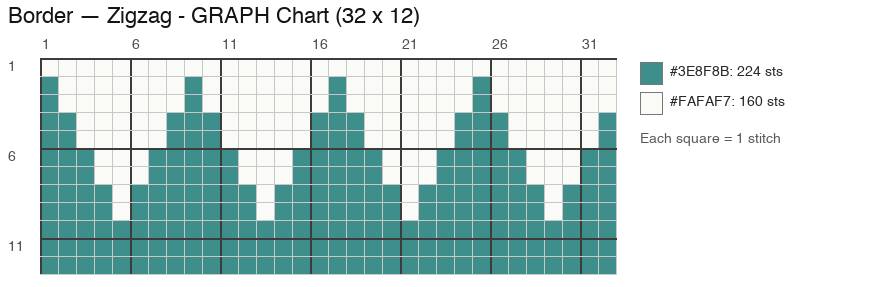
Zigzag Border crochet chart, 32 × 12 stitches, 2 colors

12 rows

Click the chart to jump to a row · Progress saves in your browser — no account needed 💕

Rendered previewZigzag Border as worked crochet fabric — simulated stitch texture
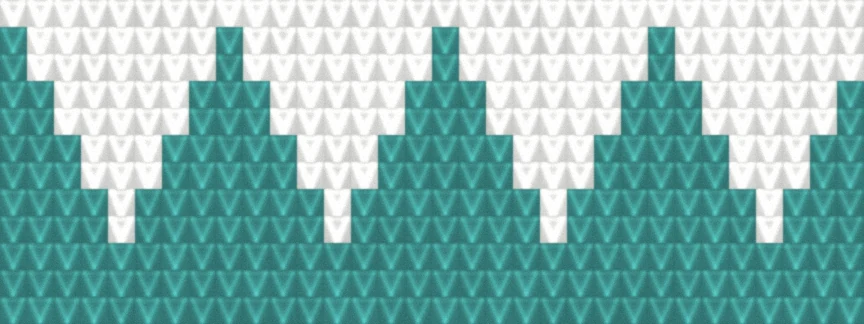
Simulated stitch texture from the chart grid — not a photo.

Zigzag Border

Difficulty
Beginner
Technique
Edging strip (single crochet)
Chart size
32 × 12 stitches
Colors
2
Yarn needed
≈ 25 yds per repeat strip
Source
Original pixel design

Sharp chevron points rising from a 2-row base in teal. Repeat is a multiple of 8 — the friendliest number in blanket math; it divides into nearly every edge count.

Download chart (PNG) ⬇️
Written instructions (row by row)

Work from the bottom up. Odd rows are the right side (worked right-to-left), even rows the wrong side (left-to-right). Tap a row to mark it done — the chart shades it too.

creamteal
Digital preview
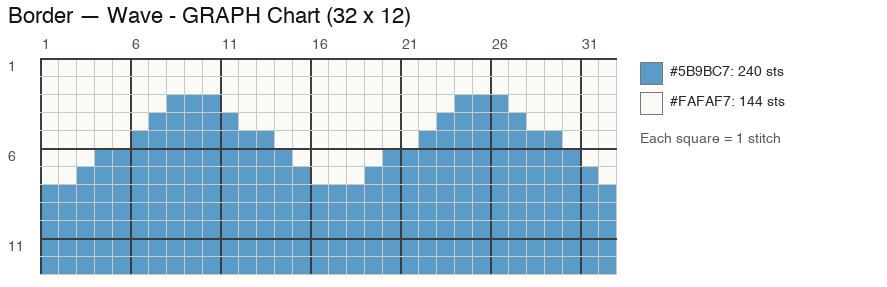
Wave Border crochet chart, 32 × 12 stitches, 2 colors

12 rows

Click the chart to jump to a row · Progress saves in your browser — no account needed 💕

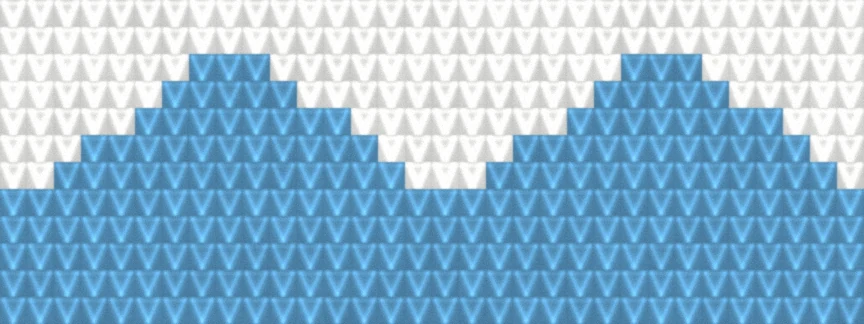
Rendered previewWave Border as worked crochet fabric — simulated stitch texture

Simulated stitch texture from the chart grid — not a photo.

Wave Border

Difficulty
Easy
Technique
Edging strip (single crochet)
Chart size
32 × 12 stitches
Colors
2
Yarn needed
≈ 25 yds per repeat strip
Source
Original pixel design

A soft sine swell in sky blue, repeat of 16 — calmer than the zigzag and the natural partner for ripple-blanket edges, where it continues the wave instead of fighting it.

Download chart (PNG) ⬇️
Written instructions (row by row)

Work from the bottom up. Odd rows are the right side (worked right-to-left), even rows the wrong side (left-to-right). Tap a row to mark it done — the chart shades it too.

creamsky blue
Digital preview
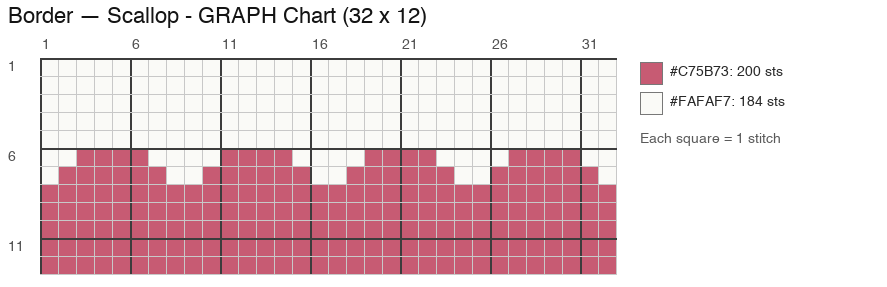
Scallop Border crochet chart, 32 × 12 stitches, 2 colors

12 rows

Click the chart to jump to a row · Progress saves in your browser — no account needed 💕

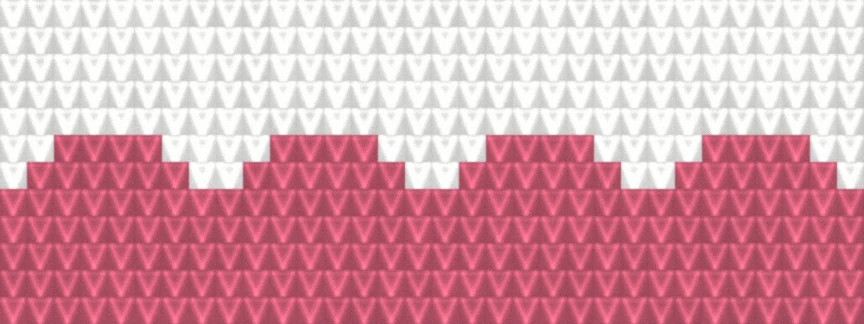
Rendered previewScallop Border as worked crochet fabric — simulated stitch texture

Simulated stitch texture from the chart grid — not a photo.

Scallop Border

Difficulty
Easy
Technique
Edging strip (single crochet)
Chart size
32 × 12 stitches
Colors
2
Yarn needed
≈ 25 yds per repeat strip
Source
Original pixel design

Semicircle shells in rose, repeat of 8 — the vintage edging. In real stitches each arc is a 5-double-crochet shell; on granny blankets, land each shell on a chain space and it looks inherited.

Download chart (PNG) ⬇️
Written instructions (row by row)

Work from the bottom up. Odd rows are the right side (worked right-to-left), even rows the wrong side (left-to-right). Tap a row to mark it done — the chart shades it too.

creamrose
Digital preview
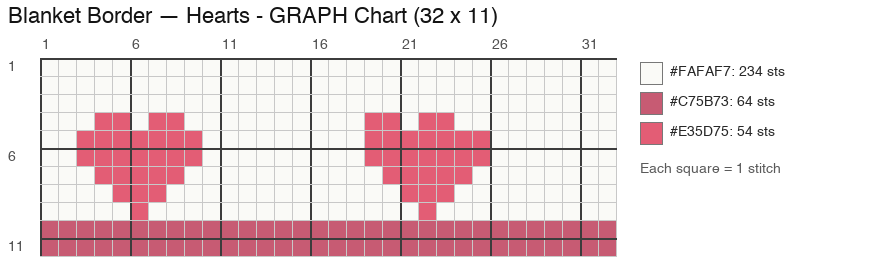
Heart Border crochet chart, 32 × 11 stitches, 3 colors

11 rows

Click the chart to jump to a row · Progress saves in your browser — no account needed 💕

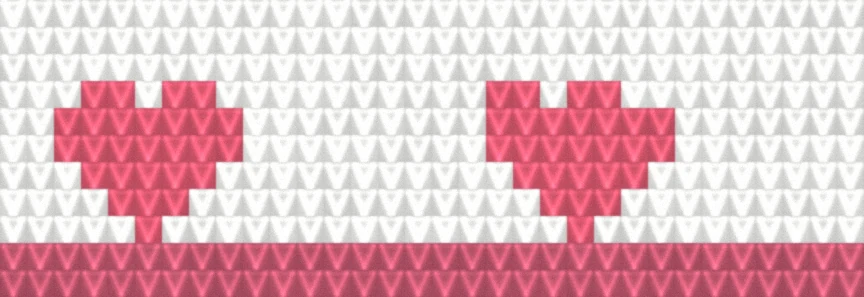
Rendered previewHeart Border as worked crochet fabric — simulated stitch texture

Simulated stitch texture from the chart grid — not a photo.

Heart Border

Difficulty
Easy
Technique
Edging strip (single crochet)
Chart size
32 × 11 stitches
Colors
3
Yarn needed
≈ 25 yds per repeat strip
Source
Original pixel design

54 rose-red stitches per heart sitting on a rose base, repeat of 16 — two hearts shown; work as many as your edge divides into. The baby-blanket border.

Download chart (PNG) ⬇️
Written instructions (row by row)

Work from the bottom up. Odd rows are the right side (worked right-to-left), even rows the wrong side (left-to-right). Tap a row to mark it done — the chart shades it too.

creamrose redrose
Digital preview
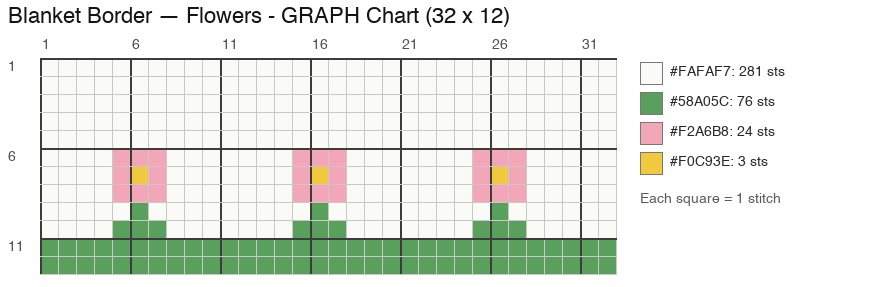
Flower Border crochet chart, 32 × 12 stitches, 4 colors

12 rows

Click the chart to jump to a row · Progress saves in your browser — no account needed 💕

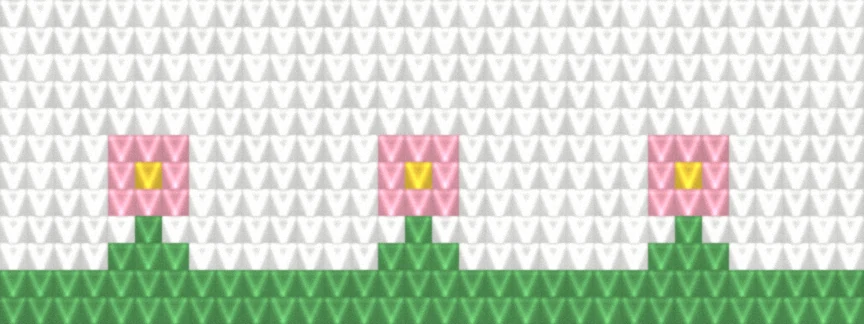
Rendered previewFlower Border as worked crochet fabric — simulated stitch texture

Simulated stitch texture from the chart grid — not a photo.

Flower Border

Difficulty
Easy
Technique
Edging strip (single crochet)
Chart size
32 × 12 stitches
Colors
4
Yarn needed
≈ 25 yds per repeat strip
Source
Original pixel design

Three daisies with stems growing off a leaf-green base, repeat of 10 — a garden edge for plain single-crochet blankets that need exactly one thing.

Download chart (PNG) ⬇️
Written instructions (row by row)

Work from the bottom up. Odd rows are the right side (worked right-to-left), even rows the wrong side (left-to-right). Tap a row to mark it done — the chart shades it too.

creampinkyellowleaf green

How to crochet it

  1. Gather your materials

    The same yarn and hook as the blanket you're edging — a border in a different weight telegraphs immediately. Yardage: roughly 25 yards per 32-stitch repeat strip at these heights, so a 100 cm square throw (≈ 4 sides × 60 stitches) uses about 150–200 yards of border color.

  2. Count your edge and check the multiple

    Each border repeats every N stitches: zigzag 8, wave 16, scallop 8, heart 16, flower 10. Count the stitches along one blanket edge; if it's not a multiple, adjust with a setup round — add or skip a stitch every so often until the count divides. Do this once and the repeat lands perfectly on every side.

  3. Work the two base rows first

    The bottom two rows of every chart are a solid single-crochet foundation — work them all the way around the blanket with 3 sc in each corner. This alone fixes curling and wobble; everything above it is decoration.

  4. Build the shaped edge

    Follow the chart upward from the base: the colored cells are stitches, the cream cells are skipped (worked as decreases in single crochet, or as taller stitches where the edge rises). The shape appears over one full repeat — don't judge it on the first 8 stitches.

  5. Turn the corners deliberately

    On geometric borders, place a corner at the peak of a repeat unit — a zigzag point or a scallop center reads as intentional. On heart and flower borders, center a motif on the corner. Decide where the corner lands during the setup round, not when you reach it.

  6. Block the border flat

    Wet-block or steam the finished edging, pinning the points of zigzags and the arcs of scallops open. Borders are 90% of what people photograph — five minutes of pinning is the difference between homemade and handmade.

Make your own chart

Have a photo you love? The free generator turns it into a stitch-ready chart — grid, palette, and stitch counts included.

Frequently asked questions

What is the easiest crochet blanket border?

The zigzag: one color, a multiple-of-8 repeat that fits almost every blanket, and the shape is just increases and decreases on a single-crochet base. If you can make the blanket, the zigzag is a victory lap.

How do I know if a border will fit my blanket?

Divide your edge stitch count by the repeat multiple (zigzag 8, wave 16, scallop 8, heart 16, flower 10). If it divides evenly, the border lands exactly. If not, add a setup round of single crochet, increasing or decreasing a few stitches until it does — the setup round hides the adjustment.

Should the border match the blanket or contrast?

Match for texture (a scallop in the main color reads as elegant shadow), contrast for a frame (a dark border on a pale blanket looks bound, like a quilt). Rule of thumb: busy blanket, quiet border; plain blanket, picture border like the hearts or flowers.

Does a border stop a blanket from curling?

Yes — the two base rows of single crochet worked around the edge are the standard anti-curl treatment, and every chart here starts with them. Severe curl also wants blocking; the border plus blocking fixes what tension couldn't.

Can I use these edgings on things other than blankets?

Everything with an edge: towel hems, pillowcases, table runners, sleeve cuffs, the bottom of a plain cardigan. The heart and flower borders on a plain kitchen towel are a 30-minute gift.